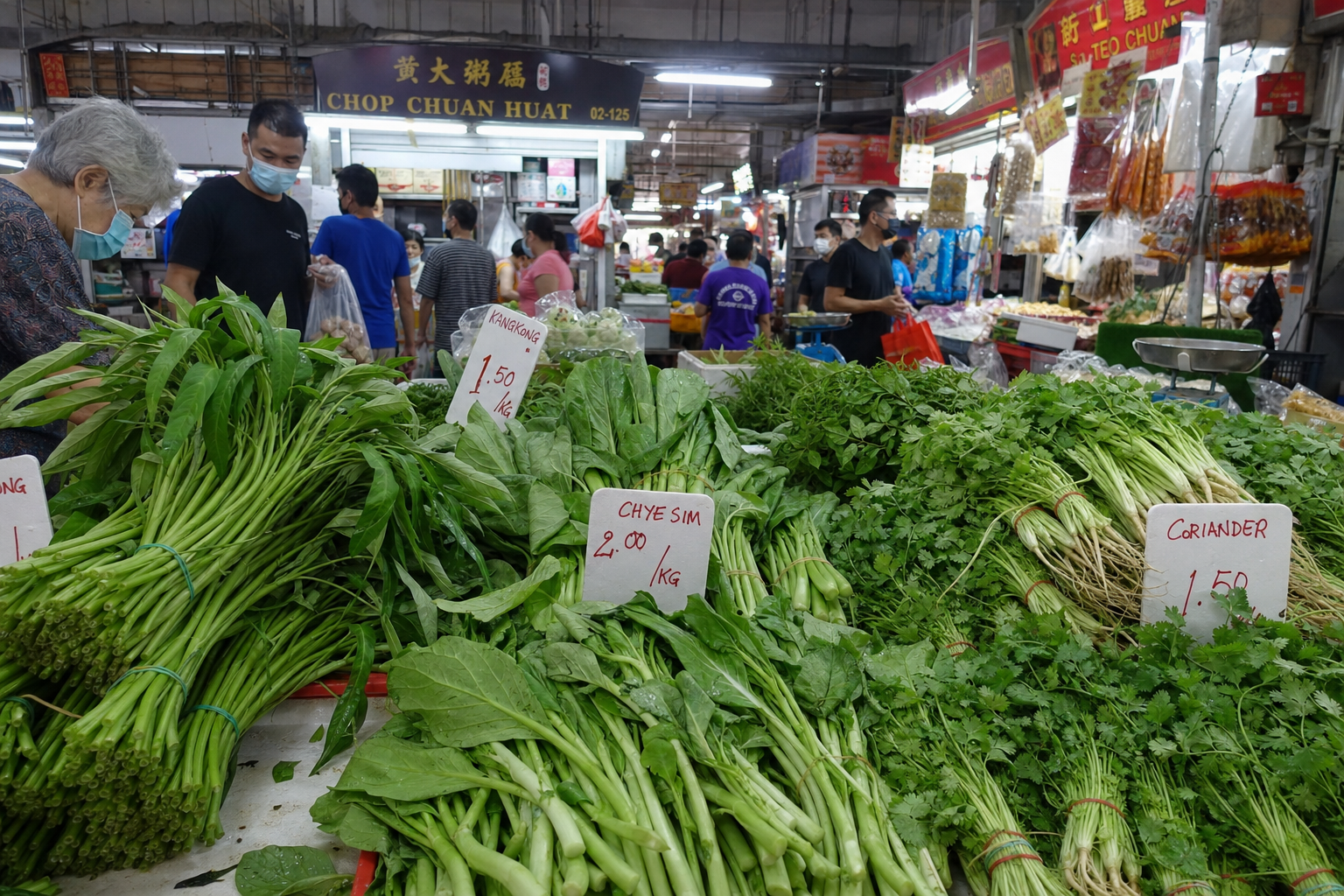
I set my alarm for six on Saturday, which is earlier than the slope requires but exactly when Chinatown Complex begins its real work. By six-thirty the wet market on the ground floor is already loud — stallholders shouting prices, metal trolleys clattering on tile, the wet sound of vegetables being rinsed in plastic basins. I take the bus down from Chin Swee Road and arrive while the morning is still grey, before the sun has reached the market's fluorescent tubes and made them redundant.
The Complex is a building I have been coming to since I moved to the slope, though I cannot claim the familiarity of someone who has shopped here for decades. The aunties who run the vegetable stalls know me now — not by name, but by face and by the fact that I always buy kangkong and always ask for coriander even when it is not in season. "Coriander expensive today," the auntie at stall seven told me this morning, holding up a bunch like evidence. "You want or not?" I wanted. She sighed the sigh of a woman who disapproves of my choices but respects my consistency, and added the coriander to my bag without charging me the premium she had announced.
The market on Saturday morning has a particular density. Not crowd density — though it is crowded — but sensory density. The smell of fresh greens mixed with the smell of fish from the adjacent stalls and the underlying smell of wet concrete that never fully dries in a wet market. The sound of Cantonese and Mandarin and the occasional English word shouted across aisles. The visual overload of colour — dark green kangkong, pale green chye sim, orange carrots, purple eggplant, red chillies piled in pyramids that collapse and are rebuilt throughout the morning.
I walked the aisles slowly, which is the wrong way to shop at a wet market on Saturday and the only way I know how to shop anywhere. Stall seven for greens — kangkong, chye sim, a small bunch of spring onions. Stall twelve for tofu — firm, two blocks wrapped in plastic and placed flat in my bag so they would not crack. Stall three for eggs, which the uncle counts aloud as he packs them, tapping each one against the carton to prove solidity. I bought more than I needed, which is always what happens when you shop while hungry and the vegetables look alive under the lights.
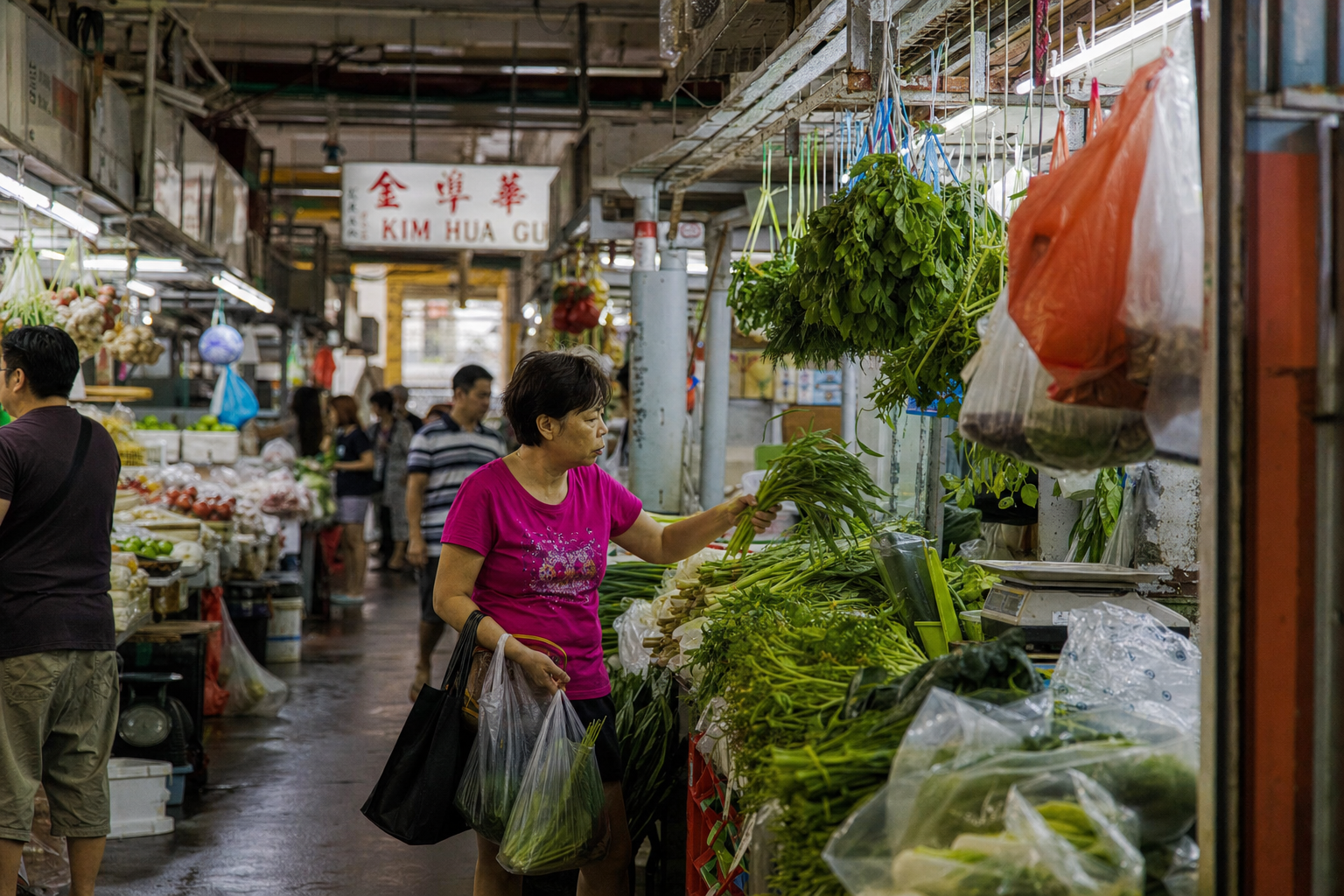
What I come to the Complex for, beyond the vegetables, is the instruction. Wet market aunties and uncles dispense advice without being asked — how to pick a ripe papaya, why this fish is better than that fish, which stall has the freshest bean sprouts on which day of the week. This morning the auntie at stall seven told me my kangkong was too mature. "This one better," she said, swapping my bunch for one with thinner stems. "You blanch too long, that's why. Thirty seconds. Not one minute." I nodded. She was probably right. I blanch everything too long because I am afraid of undercooking and the fear makes me cautious and the caution makes everything soft.
By eight the market was filling with the weekend crowd — families with children, domestic helpers with employer lists on their phones, old men buying exactly one fish and discussing its quality with the stallholder as if the negotiation were ceremonial rather than financial. The temperature was rising. The fluorescent tubes were losing their battle with the morning sun that came through the high windows in pale rectangles. I paid for my last item — ginger, a small knob, because the auntie said I would need it for the kangkong — and moved toward the exit, past the cooked food stalls that were opening for breakfast, past the smell of soy sauce and frying oil, out into the February morning that was already warm.
I took the bus back up the slope with two plastic bags that cut into my fingers. At Blk 8 I climbed the stair flights slowly so nothing would bruise. In the flat I unpacked the vegetables on the counter and looked at them — kangkong, chye sim, coriander, spring onions, tofu, eggs, ginger — arranged in a row like items on a receipt. I blanched the kangkong for thirty seconds, as instructed. It was crisp and bright green and tasted like the market smelled at six-thirty in the morning: alive, wet, temporary.
Saturday greens are a small ritual — not sacred, not essential, just the way I mark the week ending and beginning. The Complex will be there next Saturday. The auntie at stall seven will sigh at my coriander habit. The uncle will count eggs aloud. The slope will receive me back with its stair flights and its landing lamp and its void-deck chess table, and the vegetables will go in the fridge and be eaten by Tuesday. That is enough. That is the whole note.
— Lex