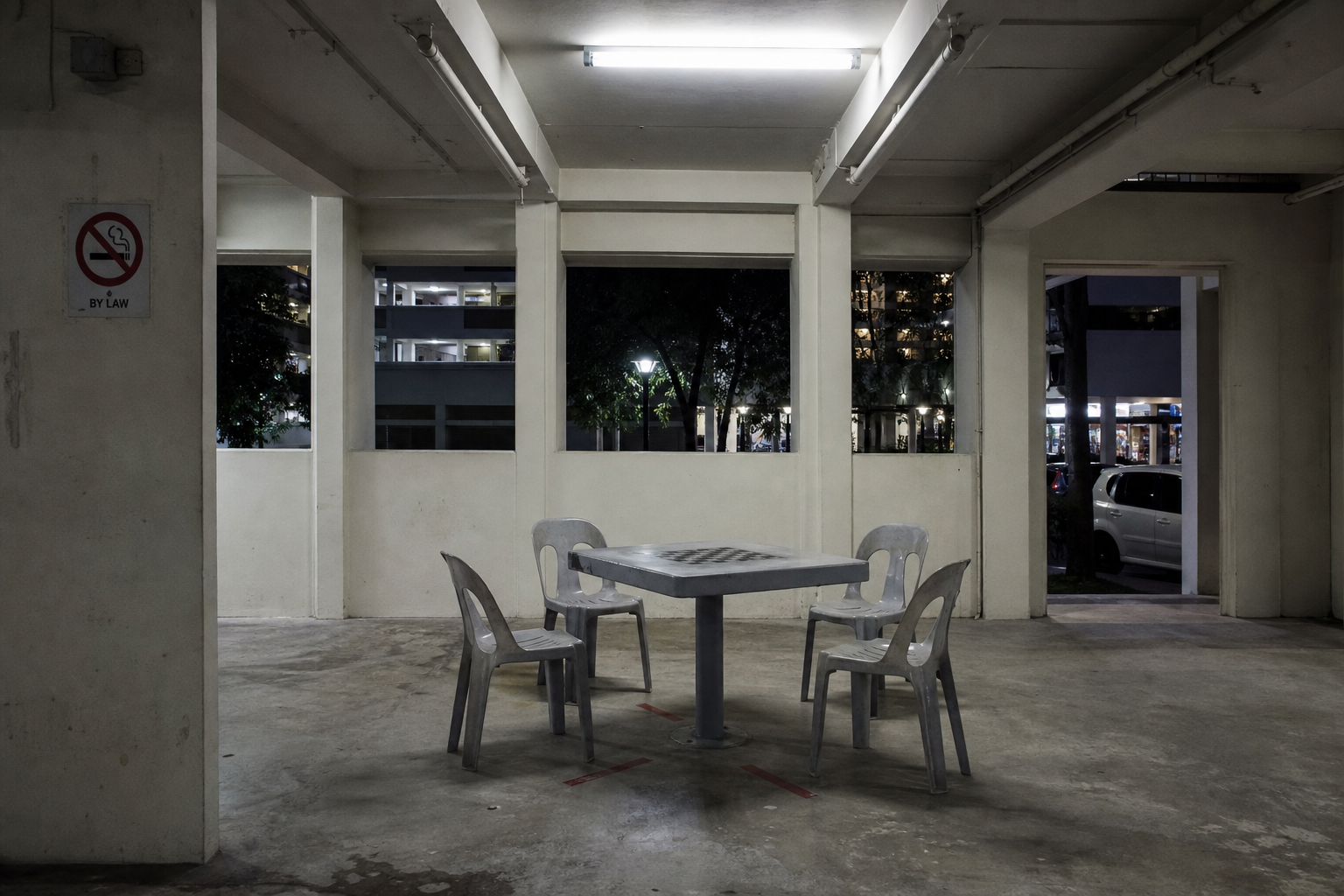
The void deck at Blk 8 has four concrete pillars, eight plastic chairs stacked against the wall when not in use, and one chess table that has been here since before I moved in. The table is cement, with a chessboard painted on top in black and white squares that have faded to grey and off-white over the years. The pieces are stored in a metal biscuit tin under the table — I have looked; the tin is dented and the lid does not close properly. On most evenings the void deck is empty except for the fluorescent tube humming above and the faint smell of cooking drifting down from the upper floors.
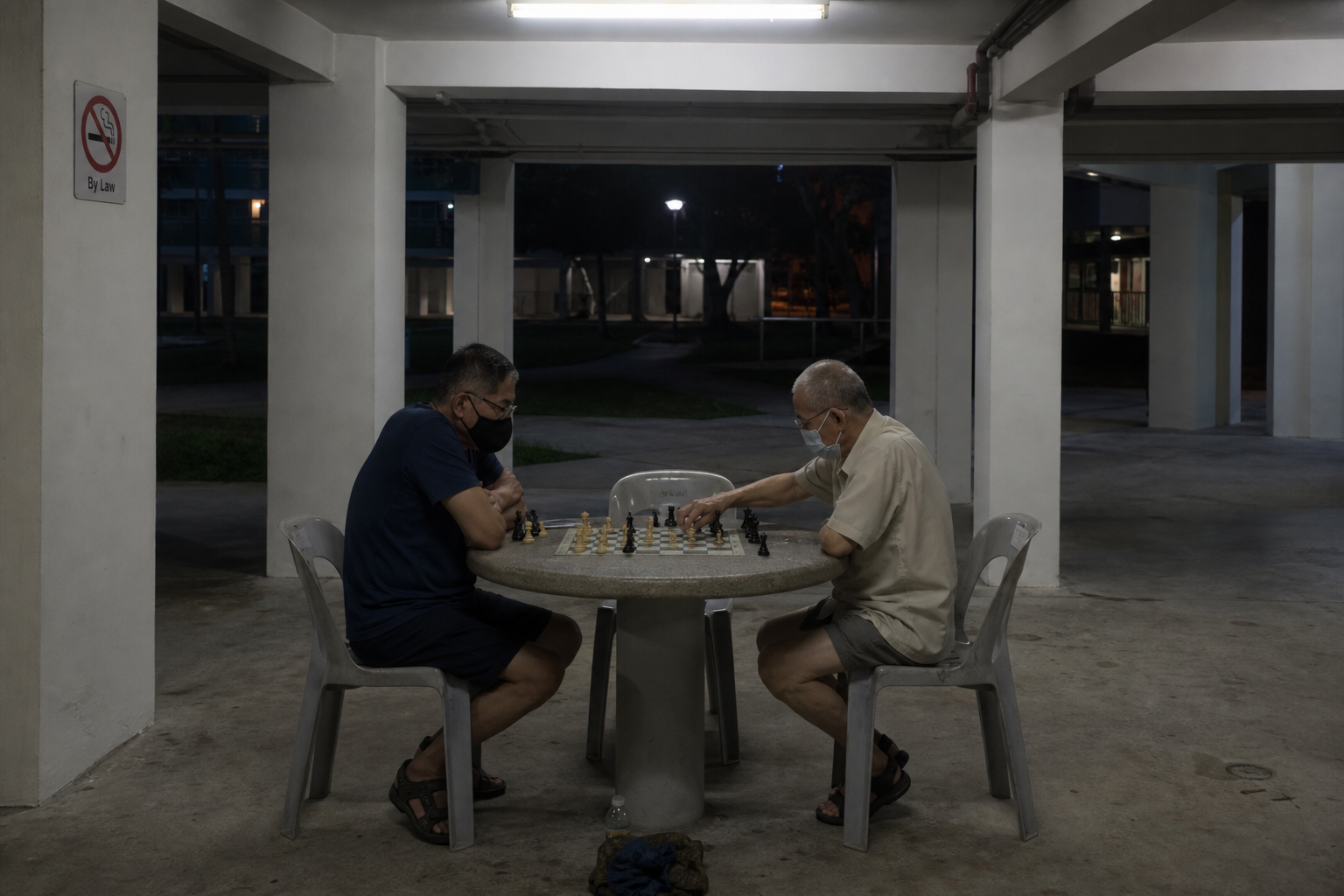
On this Tuesday evening two uncles were playing. I had come down to check the letterbox and stayed because the game was at that stage where both players know the end is approaching but neither wants to be the one who ends it. Uncle Lim — I know his name because he lives on the fifth floor and always greets me in the lift — was white. Uncle Raj, who I know less well, had black. They sat on opposite sides of the table on plastic chairs that bow slightly under their weight. Between them, the board showed a position I could not fully read: white's queen active on the kingside, black's rook defending a weakened pawn structure, both kings still in their starting neighbourhoods but no longer safe there.
I sat on the stacked chairs at the edge of the void deck and watched without commenting. This is the etiquette of void-deck chess: spectators are welcome but should not speak unless asked. The fluorescent tube cast a flat white light that eliminated shadows — the pieces looked like cut-outs on the board, without depth. Uncle Lim moved his knight. Uncle Raj responded with a pawn push that opened a line toward Lim's king. Lim frowned, which for him is a significant expression — he is a man who treats frowning as a private act.
The void deck is a room without walls. Open on three sides, ceiling at the floor above, floor at the ground below. Wind moves through it freely. Sound moves through it too — the lift ding from the adjacent block, a child crying two floors up, the distant traffic on Chin Swee Road. But when two people are playing chess at the table, the void deck becomes a room with walls made of concentration. The outside world continues, but the players have agreed to pretend it does not.
I counted the pieces. Three moves left, I estimated — though I am a poor chess player and my estimates are often wrong. Uncle Raj had a material advantage but Lim had initiative, which in void-deck chess is worth more than a pawn because void-deck chess is not tournament chess. It is chess played between men who have known each other for years, who have played hundreds of games on this same table, who remember each other's tendencies the way you remember the creak of a stair tread. Lim always pushes pawns late. Raj always trades queens too early. These are not weaknesses — they are signatures.
Uncle Raj made his move — a rook lift that threatened mate in two if Lim did not respond precisely. Lim studied the board for four minutes. I know it was four minutes because I checked my phone once and then put it away, deciding that timing the pause would be rude. Four minutes on a void deck is a long time. The fluorescent tube buzzed. A neighbour walked through the void deck carrying groceries and paused to look at the board before continuing to the lift. Lim moved his king one square. Raj nodded, as if he had expected this, and countered with a check that forced the king back.
The game ended six moves later, not three — my estimate was wrong, as usual. Raj won. Lim tipped his king over with two fingers, a gesture of concession that looked more like affection than defeat. They reset the board without speaking, set up the pieces for a new game, and began again as if the previous hour had not happened. I left them there and took the lift back to the second floor, where my flat was quiet and the window showed the void deck from above — two small figures at a table, pieces between them, the fluorescent light a rectangle of white in the growing dark.
Void-deck chess is one of the things the slope keeps without writing down. No score sheets, no clocks, no rankings. Just the table, the tin of pieces, and the uncles who arrive most evenings to play games that matter only for the duration of the playing. I write it here because I want the table to have a record — not of who won, but of the fact that it existed on this Tuesday, under this light, with three moves left that became six and then a new beginning.
— Lex