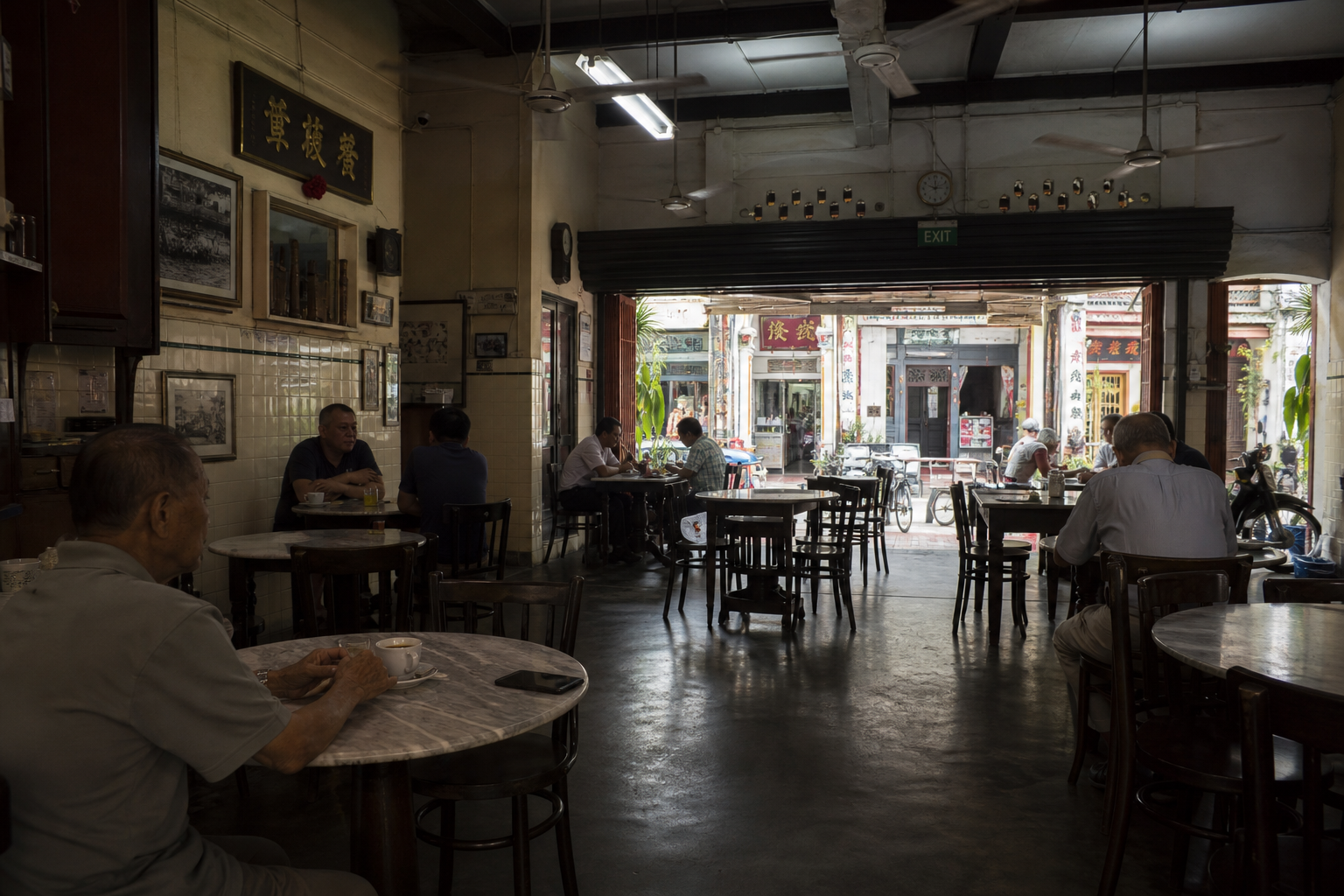
Wednesday morning I walked down from Blk 8 before the slope had fully woken. The stair flights were still cool — night heat stored in the concrete but not yet released into the air. At the foot of the slope I turned toward Kreta Ayer, past the provision shop with its metal shutters half-raised, past the uncle sweeping the footpath with short efficient strokes. The coffeeshop on Smith Street was already open. It always is by six-thirty, though on Wednesdays the crowd arrives later and the room keeps its midweek shape: unhurried, slightly sparse, the way a room looks when nobody is performing being busy.
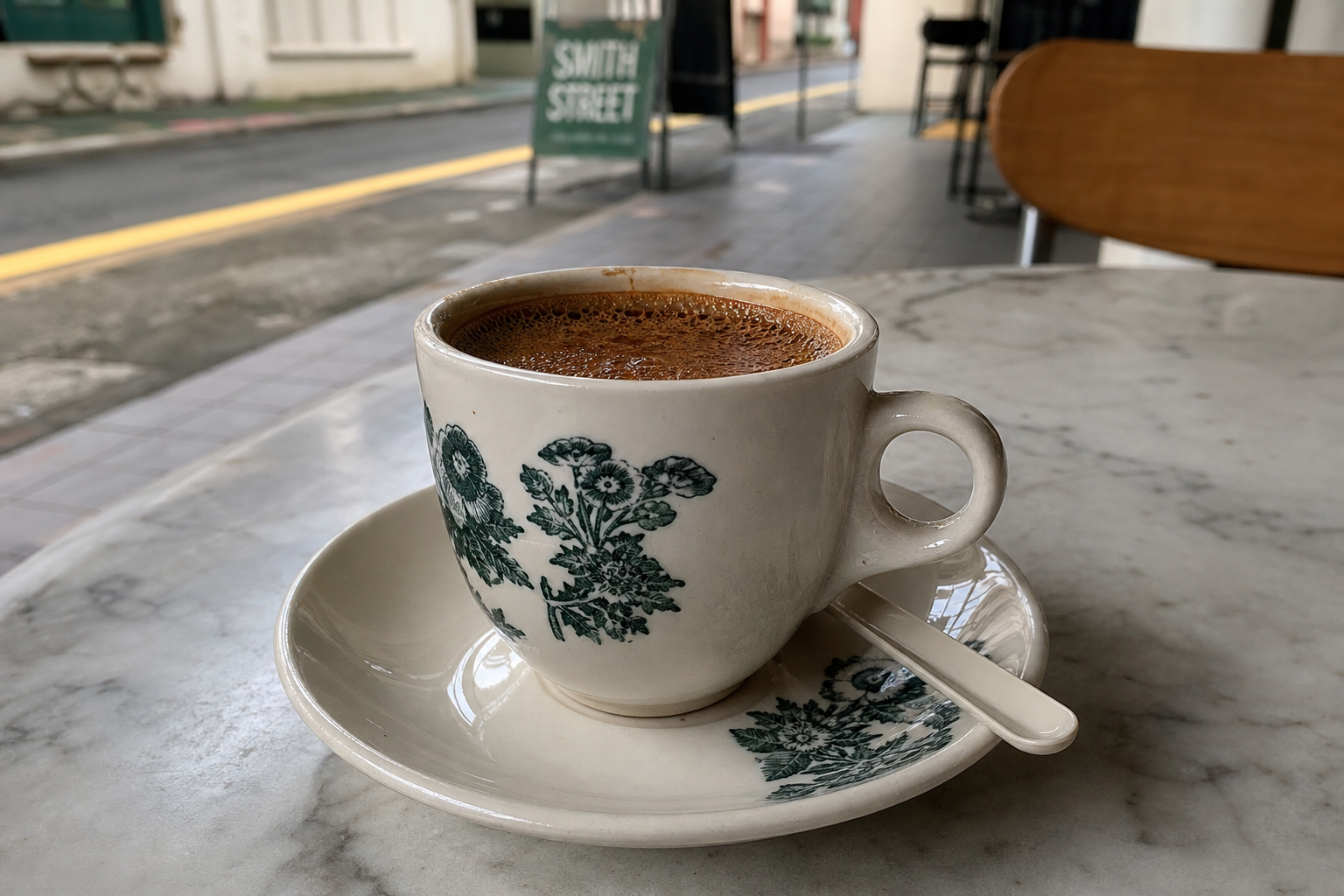
I took the corner table — the one by the window where you can see the footpath and the old shophouse facades across the street. The table is marble-topped, rimmed with green laminate that has chipped at the corners from decades of elbows and cups. I ordered kopi si kosong from the auntie who has worked this shift since before I moved to the slope. She nodded without looking up from the sock she was filling with coffee grounds. The kopi came thick, slightly bitter, served in a glass with a saucer — the kind of cup that burns your fingers if you grip it too soon.
What I come here for is not the coffee, though the coffee is adequate. It is the room itself — the ceiling fans turning slow enough that you can count the blades, the fluorescent tubes buzzing at a frequency you stop hearing after the first minute, the tile floor mopped to a dull shine that reflects the legs of plastic chairs. On Wednesdays the regulars arrive in a particular order. First the uncle with the Chinese newspaper folded under his arm, who takes the table near the kitchen and reads without ordering for twenty minutes. Then the two aunties who share a table and talk in low Teochew about grandchildren and market prices. Then, around eight, the office workers cutting through on their way to Outram, grabbing takeaway kopi in plastic bags that sweat in the humidity.
I sat and watched the footpath through the window. A delivery rider paused to check his phone, his thermal bag resting against the kerb. An old woman descended from a bus stop bench and crossed the road with the careful deliberation of someone who has learned that cars will wait if you walk slowly enough. The shophouses across the street showed their age without apology — paint peeling in long strips, air-conditioning units stacked like afterthoughts, a cat sleeping on a window ledge in the only patch of shade.
The coffeeshop has been here longer than the tower blocks on the slope. You can tell by the fixtures — the original tile work behind the counter, the metal cash drawer that clangs when the auntie slams it shut, the menu board handwritten in three languages with prices that change in pencil rather than print. Nothing here has been renovated to look old. It simply is old, and the midweek mornings preserve it the way a photograph preserves a room: without trying, without comment.
I finished my kopi and ordered a second cup without deciding to — the auntie had already turned toward the sock before I raised my hand. The uncle with the newspaper had moved to the sports section. One of the Teochew aunties laughed at something and the sound bounced off the tile and settled into the general hum of the room. Outside, the footpath was filling with the ordinary traffic of a Wednesday: schoolchildren in uniform, a man pushing a trolley of cardboard, the smell of frying dough from a stall further down Smith Street.
I left when the lunch preparation started — clatter of woks from the kitchen, the auntie shouting an order to the back, chairs scraping as the room rearranged itself for the midday crowd. Walking back up the slope I could feel the coffee working in my chest, a small warmth that matched the asphalt beginning to store heat under my feet. The stair flights received me without comment. At the fourth landing I paused and looked down toward Smith Street, where the coffeeshop window was already lost in the morning glare.
Midweek kopi is not an event. It is a rhythm — one morning among hundreds, marked only because I chose to write it down before the slope forgot. The corner table will be there next Wednesday. The auntie will nod. The kopi will come thick and slightly bitter. That is enough.
— Lex